B.Tech. I & II Semester
Examination, December 2023
Grading System (GS)
Max Marks:
70 | Time: 3 Hours
Note:
i) Attempt any five questions.
ii) All questions carry equal marks.
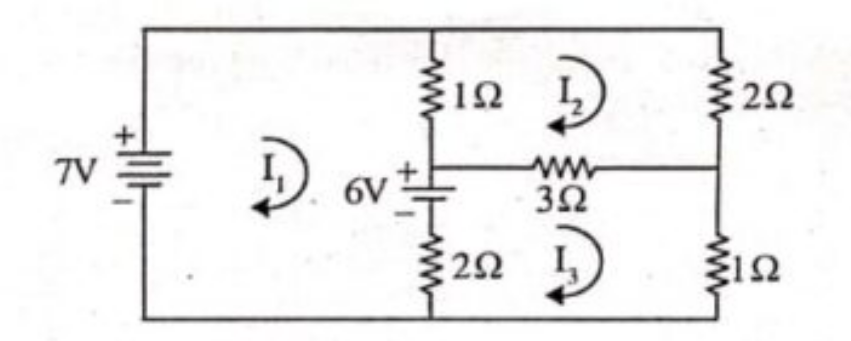
a) Use mesh analysis to determine the three mesh current in the circuit of the figure below. (Unit 1)
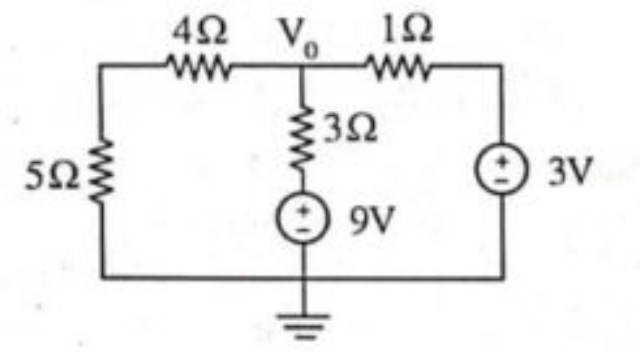
b) Using super position, find the $V_0$ in the circuit shown in figure below. (Unit 1)
a) Discuss about the Star Delta transformation using suitable example. (Unit 1)
b) Explain the following terms pertaining to an A.C. wave (Unit 2)
i) Time period
ii) RMS value
iii) Average value
iv) Form factor
a) A choke coil has resistance of 10 ohm and inductance of 0.05H is connected in series with an condenser of 100 µF. The whole circuit has been connected to 200 V, 50 Hz supply. Calculate (Unit 2)
i) Impedance
ii) Current
iii) Power Factor
iv) Real Power
b) Derive an expression of impedance, current, power factor, power in watts in RLC series circuit. (Unit 2)
a) Discuss about active, reactive and apparent power in series RLC circuits. (Unit 2)
b) Discuss about magnetization characteristics of ferromagnetic material. (Unit 3)
a) Discuss the laws of Electromagnetic induction. (Unit 3)
b) Open circuit and short circuit test on a single phase transformer gave the following results. $V_0=200V, I_0=0.7A, W_0=20$ Watt Test from primary side. $V_s=10V, I_s=10A, W_s=40$ Watt test from secondary side. Determine the equivalent circuit parameters referred to primary side. (Unit 3)
a) Draw and explain the complete Torque-slip characteristics of 3 phase induction motor. (Unit 4)
b) The core loss in a 3 phase induction motor is 100W and equals the mechanical loss, stator copper loss is 150W. When developing 2000W as the shaft power. What is the efficiency of the machine. Assume the slip as 4%. (Unit 4)
a) What do you understand by Adder circuit? Draw and explain the working principle of full adder circuit. (Unit 5)
b) In a fixed bias circuit using n-p-n transistor, find the operating point if $V_{CC}=24V, R_B=220k\Omega, R_C=4.7k\Omega$. (Unit 5)
Write a short note on any Two.
i) J-K Flip Flop (Unit 5)
ii) Dependent and Independent Sources (Unit 1)
iii) Open circuit and short circuit test (Unit 3)
iv) De-Morgan's Theorem (Unit 5)