B.Tech. I/II Semester
Examination, December 2025
Grading System (GS)
Max Marks: 70 | Time: 3 Hours
Note:
(i) Attempt any five questions.
(ii) All questions carry equal marks.
a) State the steps to solve the Thevenin's Theorem. An Electric iron is rated 1000W, 240V. Find the current drawn & resistance of the heating element. (Unit 1)
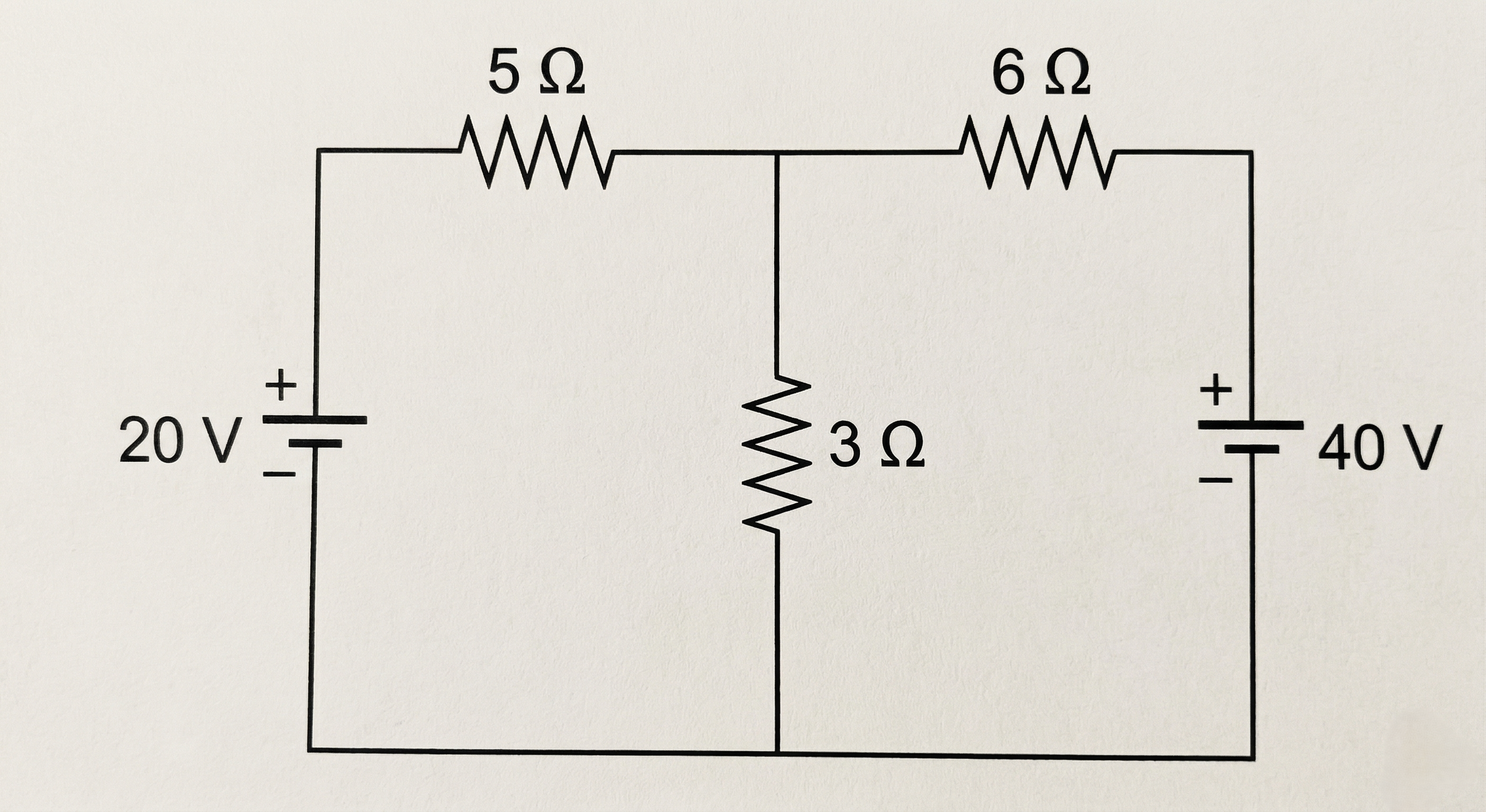
b) Find the current through 3 Ω resistor using superposition theorem in given figure. (Unit 1)
a) Explain about Star and Delta connected three phase balanced circuits. (Unit 2)
b) A series RLC circuit containing a resistance of 12Ω, an inductance of 0.15H and a capacitor of 100μF are connected in series across a 100V, 50Hz supply. Calculate the total circuit impedance, the circuits' current, power factor and draw the voltage phasor diagram. (Unit 2)
a) Derive expression for the coefficient of:
(i) Self-inductance for a solenoid coil
(ii) Mutual inductance for a pair of closely wound solenoid coils (Unit 3)
b) Discuss some of the magnetization characteristics of ferromagnetic materials. (Unit 3)
a) With a neat circuit diagram and explain the construction and principle of operation of DC Motor. (Unit 4)
b) A three phase 50Hz, 2 pole induction motor has a full speed of 2860 rpm. What is the (i) synchronous speed (ii) slip of the induction motor (iii) rotor emf frequency? (Unit 4)
a) Define α and β with respect to BJT and derive the relationship between them. For a transistor circuit having α = 0.98, $I_{CBO}$ = 5 μA and $I_B$ = 100 μA, find $I_C$ and $I_E$. (Unit 5)
b) When three balanced impedances are connected in delta across a 3 phase 400 V, 50 Hz supply the line current drawn is 20 A at a lagging p.f. of 0.3. Determine the value of the impedance connected in each phase. (Unit 2)
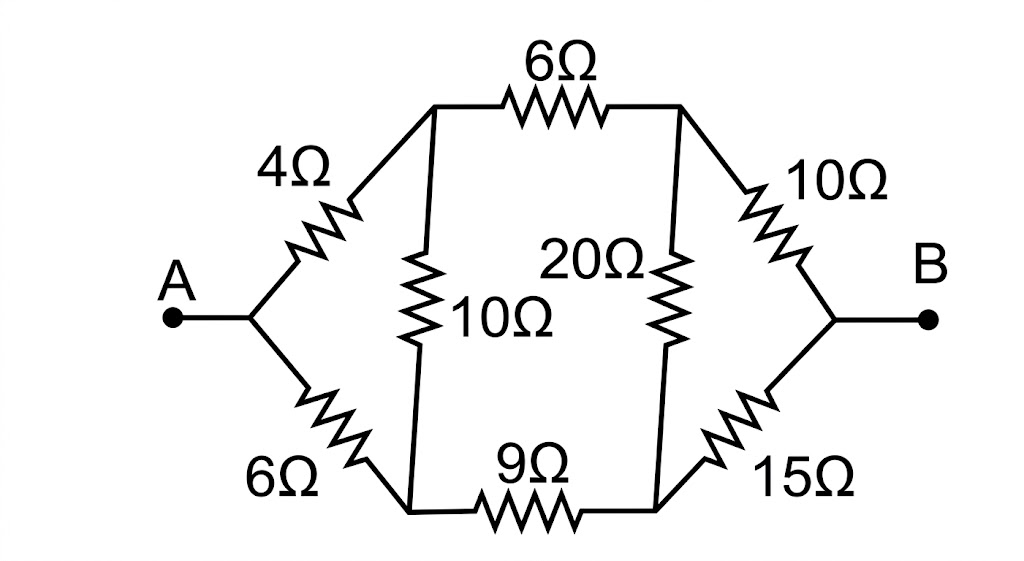
a) Determine the equivalent resistance between terminals A and B in the given figure. (Unit 1)
b) Draw the circuit of an S-R flip flop using NAND gates. Explain it. (Unit 5)
a) State and Prove Demorgan's theorem. (Unit 5)
b) Explain about open circuit and short circuit test. (Unit 3)
Write technical short note on any two of the following:
(i) Voltage and current sources (Unit 1)
(ii) Applications of DC machine (Unit 4)
(iii) Half and Full adder circuits (Unit 5)