B.Tech. I & II Semester
Examination, June 2023
Grading System (GS)
Max Marks: 70
| Time: 3 Hours
Note:
i) Attempt any five questions.
ii) All questions carry equal marks.
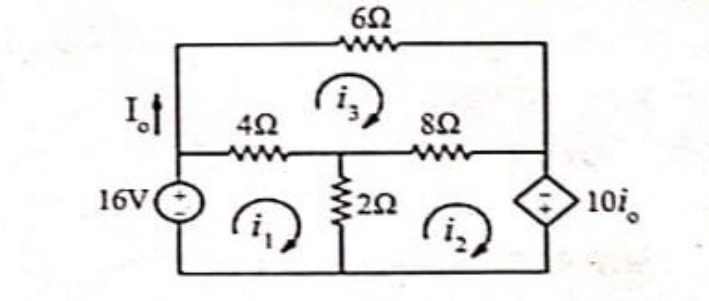
a) Using the mesh analysis, find the $I_o$ in the circuit as given below. (Unit 1)
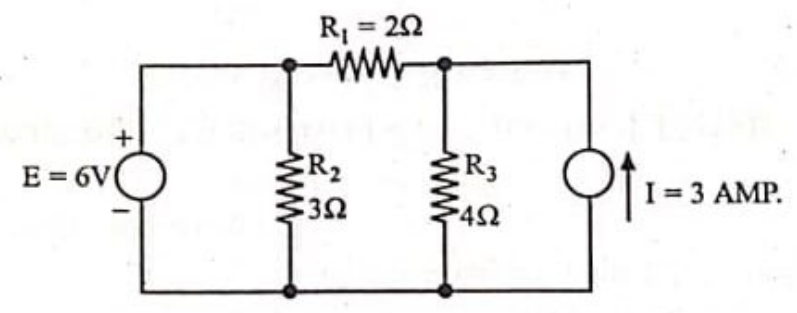
b) In the figure below, find the current flowing through $R_1$ using Thevenin's Theorem. (Unit 1)
a) What do you understand by Source. Discuss about different types of Dependent and Independent Voltage and current Sources with suitable sketch. (Unit 1)
b) Define the following: (Unit 2)
i) Alternating Quantity
ii) R.M.S. Value
iii) Average value
iv) Form factor.
v) Peak factor
a) A coil having a resistance of 10 ohms and an inductance of 0.2H is connected in series with a $100 \times 10^{-6}$ F capacitor across a 230V, 50Hz supply, Calculate: (Unit 2)
i) The active and reactive components of the current
ii) The voltage across the coil, Draw the phasor diagram.
b) A balanced star connected load of $8 + 6j$ ohm is connected across three phase, 50Hz, 440V supply system. Calculate: (Unit 2)
i) Line current
ii) Power absorbed
iii) Reactive volt ampere
a) State the different types of transformers. Describe the construction and general principle of transformer. (Unit 3)
b) What do you understand by Self inductance and mutual inductance? Derive the relation between Self inductance and Mutual Inductance. (Unit 3)
a) Open circuit and short circuit test on a single phase transformer gave the following results: $V_0=200V, I_0=0.7A, W_0=20$ Watt Test from primary side. $V_s=10V, I_s=10A, W_s=40$ Watt test from secondary side. Determine the equivalent circuit parameters referred to primary side. (Unit 3)
b) Explain the construction and working principle of three phase induction motor with suitable diagram. (Unit 4)
a) A three phase, 6 pole, 50 Hz induction motor has a slip of 1% at no load and 3% at full load, Find: (Unit 4)
i) Synchronous Speed
ii) No Load Speed
iii) Full Load Speed
iv) Frequency of rotor current at full load.
b) Discuss about types of losses occurring in electrical machine. (Unit 4)
a) Draw and explain the V-I characteristics of a PN junction. (Unit 5)
b) Draw the circuit and explain the characteristics of CB configuration. (Unit 5)
Write a short note on any two :
i) RS Flip Flop (Unit 5)
ii) Star Delta Transformation (Unit 1)
iii) De Morgan's Theorem (Unit 5)
iv) Torque-Slip Characteristics (Unit 4)