B.Tech., IV Semester
Examination, June 2024
Grading System (GS)
Max Marks: 70 | Time: 3 Hours
Note:
i) Attempt any five questions.
ii) All questions carry equal marks.
a) Obtain the asymptotic bound using the substitution method for the recurrence relation $T(n) = 3T(n/3) + n$ and represent it in terms of $\theta$ notation. (Unit 1)
b) What is Merge sort? Sort the elements 20.30.15.11.35.19.12.11.55 using Merge sort. (Unit 1)
a) Discuss Strassen's matrix multiplication and Classical O(n²) methods. Determine when Strassen's method outperforms classical method. (Unit 1)
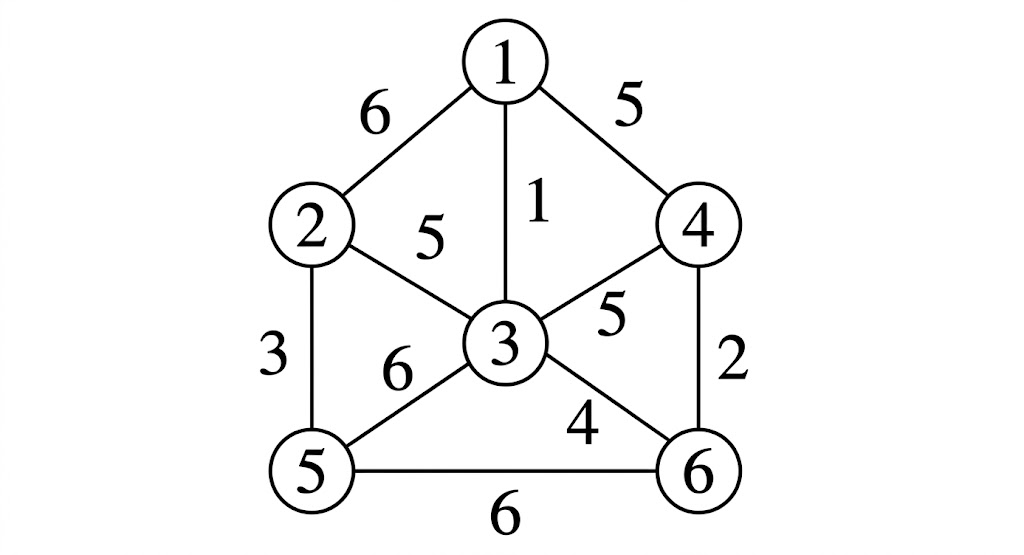
b) Define spanning tree? Construct a minimal spanning tree for the given graph using Prim's algorithm.
(Unit 2)
Solve the following problem of job sequencing with deadlines using the Greedy method.
$n = 4, (p_1, p_2, p_3, p_4) = (100, 10, 15, 27)$ and $(d_1, d_2, d_3, d_4) = (2, 1, 2, 1)$. (Unit 2)
a) Apply the greedy method to solve the 0/1 Knapsack problem for $n = 3, m = 20, (w_1, w_2, w_3) = (18, 15, 10)$ and $(p_1, p_2, p_3) = (25, 24, 15)$. (Unit 2)
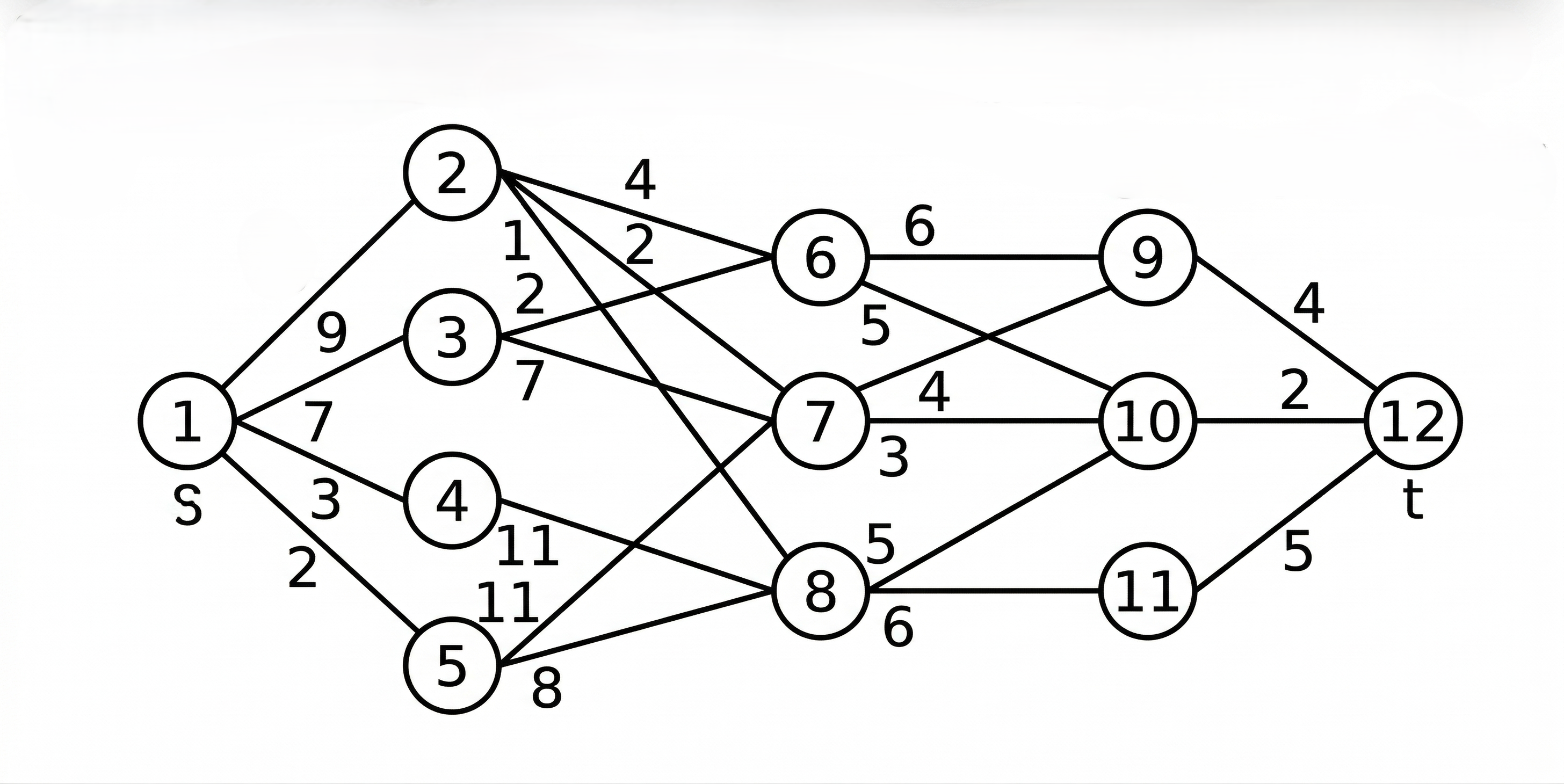
b) Construct a multistage graph for the given graph using the greedy method.
(Unit 3)
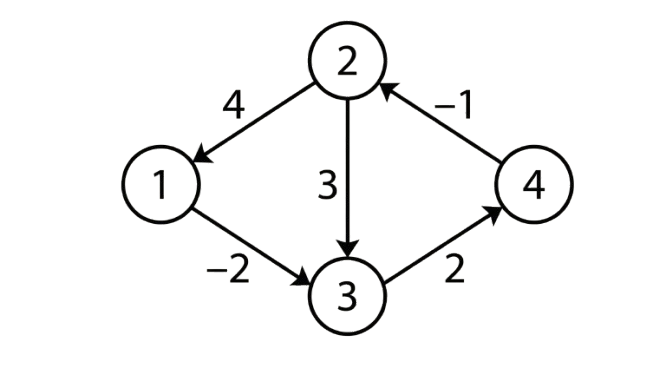
a) Explain the Floyd Warshall algorithm for the given graph.
(Unit 3)
b) Using branch and bound technique explain the 0/1 knapsack problem. (Unit 4)
a) Give the solution to the 8-queens problem using backtracking. (Unit 4)
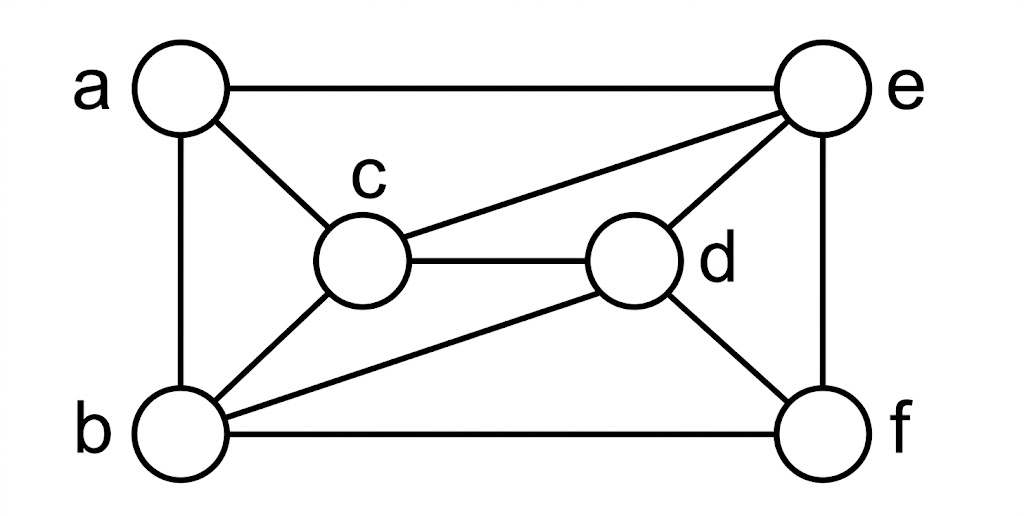
b) What is graph coloring? Explain graph coloring for the given graph.
(Unit 4)
a) Use the function OBST to compute $w(i, j), r(i, j)$ and $c(i, j), 0 \le i < j \le 4$ for the identifier set $(a_1, a_2, a_3, a_4) =$ (char, float, while, else) with $p(1) = \frac{1}{20}, p(2) = \frac{1}{5}, p(3) = \frac{1}{10}, p(4) = \frac{1}{20}, q(0) = \frac{1}{5}, q(1) = \frac{1}{10}, q(2) = \frac{1}{5}, q(4) = \frac{1}{20}$. Using $r(i, j)$'s construct the optimal binary search tree. (Unit 3)
b) Explain in detail about 2-3 Trees with an example. (Unit 5)
Write short notes on any two of the following :
a) Binary search algorithm and its time complexity (Unit 1)
b) Single source shortest path algorithm (Unit 2)
c) Parallel algorithms (Unit 4)
d) NP Completeness (Unit 5)