B.Tech., IV Semester
Examination, November 2022
Grading System (GS)
Max Marks: 70 | Time: 3 Hours
Note:
i) Answer any five questions.
ii) All questions carry equal marks.
a) Explain the different types of services in Operating system and its features. (Unit 1)
b) Define the Utility programs with example. Explain system call. (Unit 1)
a) What is Process ? Explain the process states diagram. (Unit 3)
b) Consider the set of processes with arrival time (in milliseconds), CPU burst time (in milliseconds) , and priority (0 is the highest priority) shown below. None of the processes have I/O burst time.
| Process | Arrival time | CPU Burst time | Priority |
|---|---|---|---|
| P1 | 0 | 11 | 2 |
| P2 | 5 | 28 | 0 |
| P3 | 12 | 2 | 3 |
| P4 | 2 | 10 | 1 |
| P5 | 9 | 16 | 4 |
Solve the problem using preemptive priority scheduling algorithm. Draw the Gantt chart for it. and calculate Average waiting time, Turn around time. (Unit 3)
a) Consider the resource allocation graph in the figure
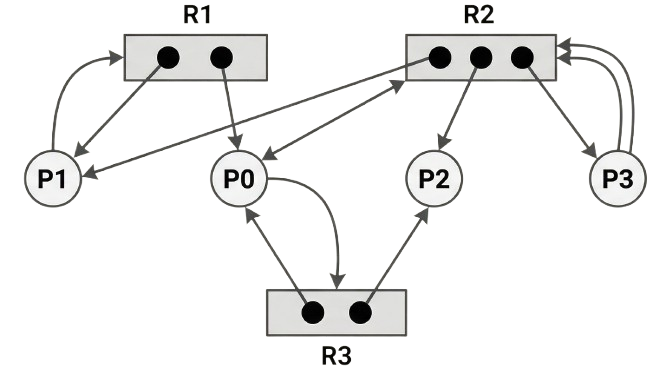
Find if the system is in a deadlock state otherwise find a safe sequence. (Unit 4)
b) Difference between Deadlock and Starvation. Explain the necessary Condition for Deadlock. (Unit 4)
a) Explain the types of Semaphores in process synchronization. (Unit 4)
b) What are the different criteria for evaluating the CPU scheduling algorithm? (Unit 3)
a) Consider a system with byte-addressable memory, 32 bit logical addresses, 4 kilobyte page size and page table entries of 4 bytes each. The size of the page table in the system in megabytes. (Unit 3)
b) Describe fixed and variable partitioned contiguous memory allocation scheme along with their merits and demerits. (Unit 3)
a) Disk request come to a disk driver for cylinders in the order 10, 22, 20, 2, 40, 6 and 38 at a time when the disk drive is reading from cylinder 20. The seek time is 6 ms/cylinder. The total seek time if the disk arm scheduling algorithm is First-Come-First-Served (FCFS), and SCAN. (Unit 2)
b) How many types of disk allocation methods describe Indexed method with merits and demerits. (Unit 2)
a) Explain the deadlock recovery in brief. (Unit 4)
b) Explain the I/O buffering and Interrupt driven operation in short. (Unit 4)
Write short notes on following (Any two):
a) Distributed operating system. (Unit 5)
b) Multiprocessor operating system. (Unit 5)
c) Network Operating system. (Unit 5)
d) Paged Segmentation. (Unit 3)