B.Tech. IV Semester
Examination, June 2023
Grading System (GS)
Max Marks: 70 | Time: 3 Hours
Note:
i) Attempt any five questions.
ii) All questions carry equal marks.
a) Explain algorithm design technique? How do you measure the algorithm running time? (Unit 1)
b) Give the divide and conquer solution for binary search and analyze the time complexity for it. (Unit 1)
a) Explain the quick sort algorithm, simulate it with the following data 20, 35, 10, 16, 54, 21, 25. (Unit 1)
b) Compute the optimal solution for job sequencing with deadlines using greedy method. $N=4$, profits $(p_1,p_2,p_3,p_4)=(100,10,15,27)$, deadlines $(d_1,d_2,d_3,d_4)=(2,1,2,1)$ (Unit 2)
a) Consider the following instance of the knapsack problem and solve it using greedy method $n=7$, $m=15$, $(p_1, p_2, p_3, p_4, p_5, p_6, p_7)=(10,5,15,7,6,18,3)$ and $(w_1, w_2, w_3, w_4, w_5, w_6, w_7)=(2,3,5,7,1,4,1)$. (Unit 2)
b) Apply the kruskal algorithm for the following graph and explain.
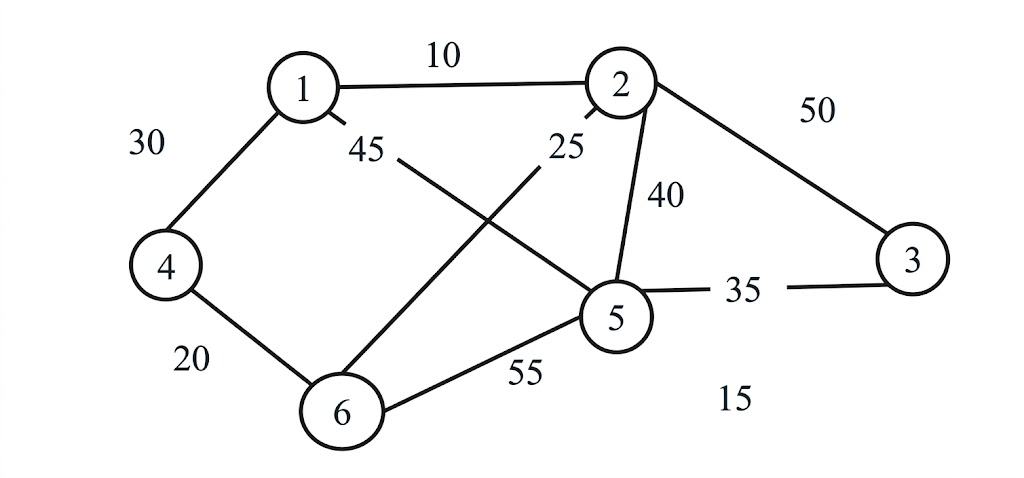
(Unit 2)
a) Solve the following $0/1$ Knapsack problem using dynamic programming $P=(11,21,31,33)$ $W=(2,12,23,15)$, $C=42$, $n=4$. (Unit 3)
b) Design a three stage reliability system with device types $d_1$, $d_2$ and $d_3$. The costs are $30, $15 and $20 respectively. The cost of the system is to be no more than $105. The reliability of each device is 0.9, 0.8 and 0.5 respectively. (Unit 3)
a) On which type of problem we apply multi stage graph technique? Explain with example. (Unit 3)
b) Briefly explain 8-queen problem using backtracking with algorithm. (Unit 4)
a) Identify the Hamiltonian cycle from the following graph.
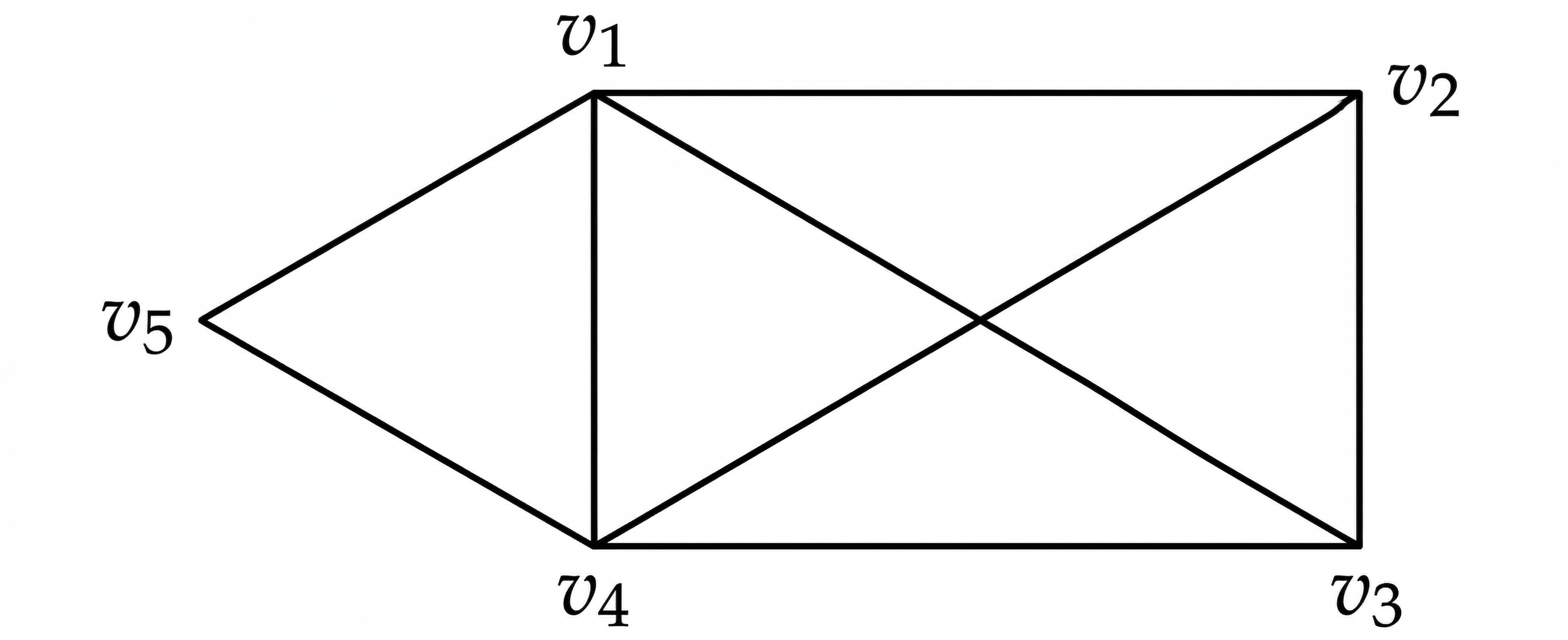
(Unit 4)
b) Write an algorithm for traveling salesperson problem using check bounds. (Unit 4)
a) Discuss the operations performed on the binary search tree for the following data: 20, 49, 41, 93, 69, 90, 76, 62, 81, 75, 10, 79, 87, 38 and delete 41 and 76. (Unit 5)
b) Differentiate between BFS and DFS. (Unit 5)
Write short notes on any two of the following.
a) 2-3 trees (Unit 5)
b) Merge sort (Unit 1)
c) Optimal merge patterns (Unit 2)
d) Floyd Warshall algorithm (Unit 3)