Rajiv Gandhi Proudyogiki Vishwavidyalaya, Bhopal
New Scheme Based On AICTE Flexible Curricula
Common to All Disciplines | First Year
2L-0T-2P 3 Credits
Unit- I : D.C. Circuits
Voltage and current sources, dependent and independent sources, Units and dimensions, Source Conversion, Ohm’s Law, Kirchhoff’s Law, Superposition theorem, Thevenin’s theorem and their application for analysis of series and parallel resistive circuits excited by independent voltage sources, Power & Energy in such circuits. Mesh & nodal analysis, Star Delta transformation & circuits.
Previous Years questions appears in RGPV exam.
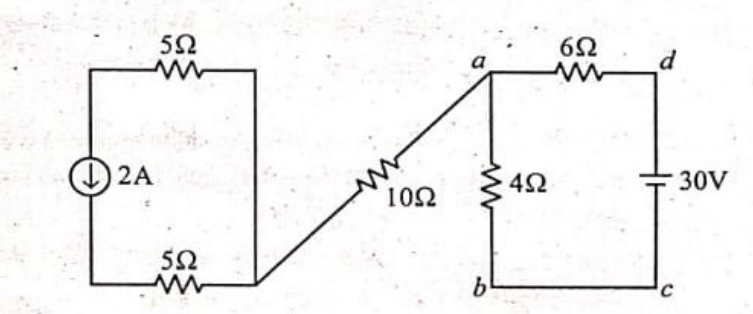
Q.1) Find the voltage $V_{ab}$ in the network shown below. (Nov-2022)
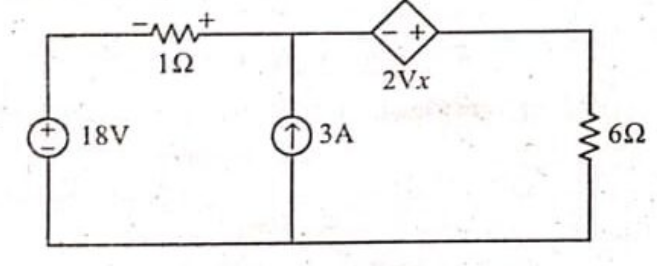
Q.2) Find the current through the $6 \Omega$ resistor using Thevenin's theorem. (Nov-2022)
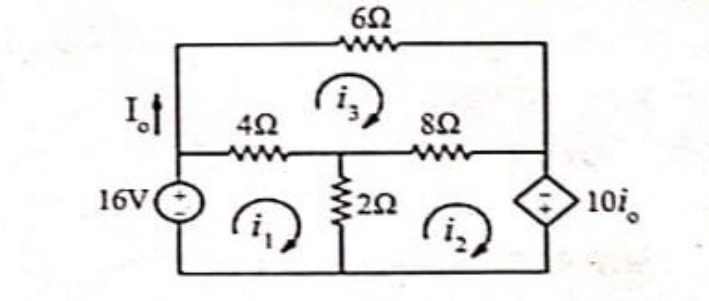
Q.3) Using the mesh analysis, find the $I_o$ in the circuit as given below. (June-2023)
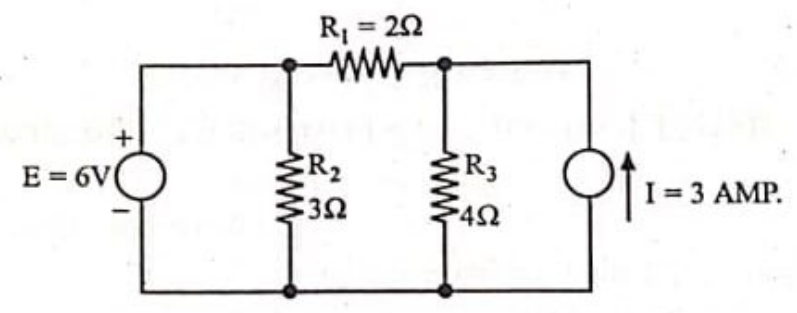
Q.4) In the figure below, find the current flowing through $R_1$ using Thevenin's Theorem.
(June-2023)
Q.5) What do you understand by Source. Discuss about different types of Dependent and Independent Voltage and current Sources with suitable sketch. (June-2023)
Q.6) Write a short note on: Star Delta transformation. (Nov-2022, June-2023, Dec-2024, June-2024)
Q.7) Use mesh analysis to determine the three mesh current in the circuit of the figure
below. (Dec-2023)
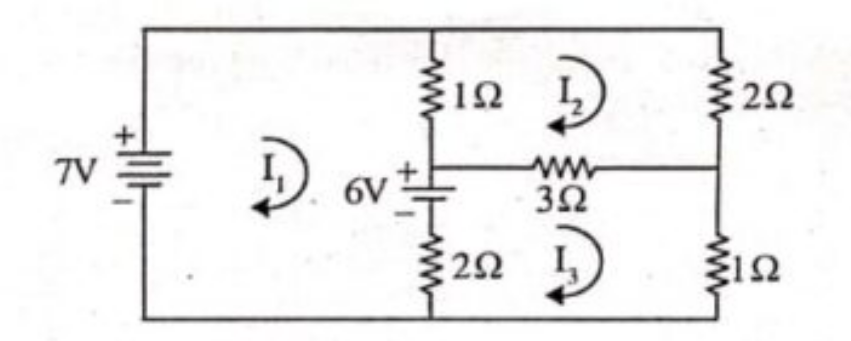
Q.8) Using super position, find the $V_0$ in the circuit shown in figure below. (Dec-2023)
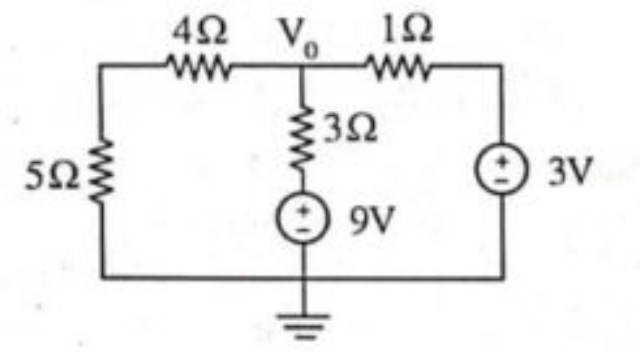
Q.9) Discuss about the Star Delta transformation using suitable example. (Dec-2023)
Q.10) Write a short note on: Dependent and Independent Sources. (Dec-2023)
Q.11) Discuss about ideal voltage source and ideal current source with neat diagram. How ideal voltage source can be converted into ideal current source. (June-2024)
Q.12) State and explain the superposition theorem with suitable example. (June-2024, June-2025)
Q.13) Using the mesh analysis, find the current through 5$\Omega$ resistor in the network as
shown in figure below. (June-2024)
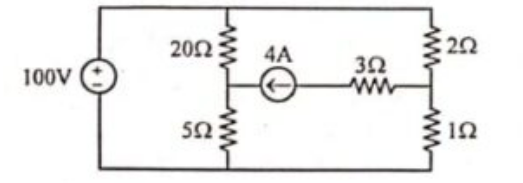
Q.14) What do you understand by dependent and independent sources? Explain with neat sketches. How can we convert a voltage source into a current source? Discuss. (Dec-2024)
Q.15) Using Nodal Analysis, find the current through the 10Ω resistor in the figure shown
below. (Dec-2024)
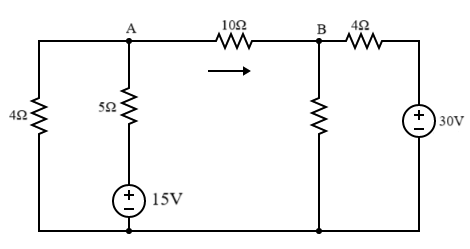
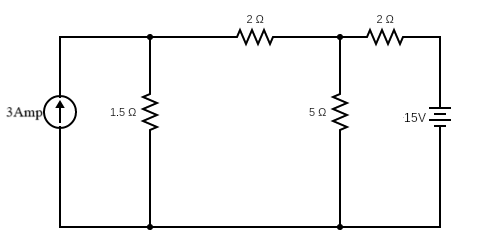
Q.16) Find the value of current in branch AB using the Superposition Theorem. Refer to the
circuit below. (Dec-2024)
Q.17) State and explain Kirchhoff's current and voltage law. (June-2025)
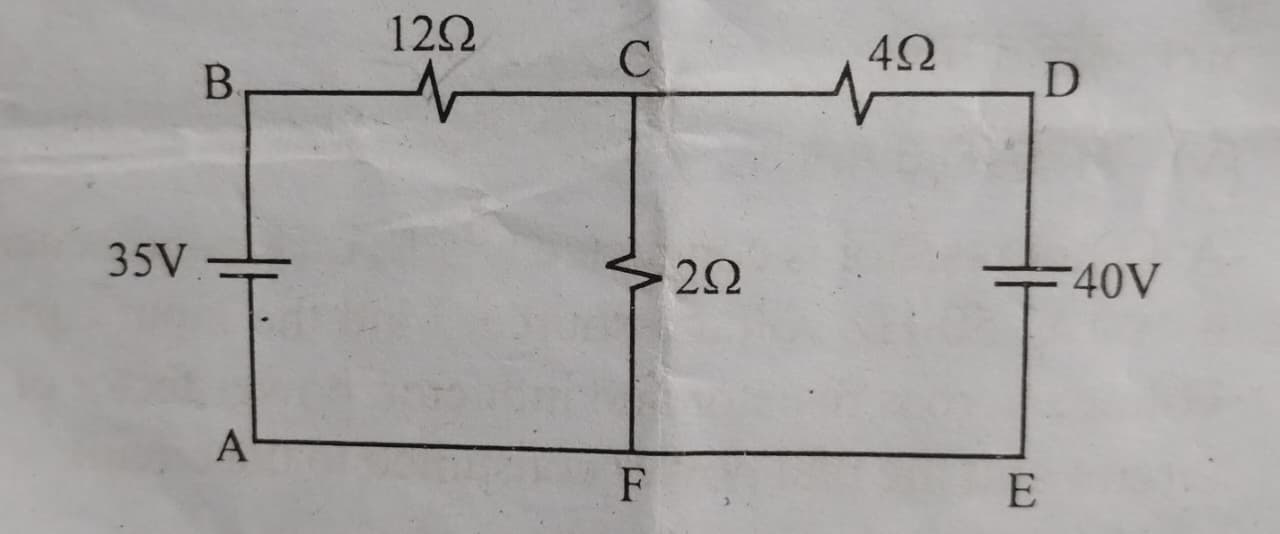
Q.18) For the circuit shown in Fig (i) find the current in 2$\Omega$ resistor. (June-2025)
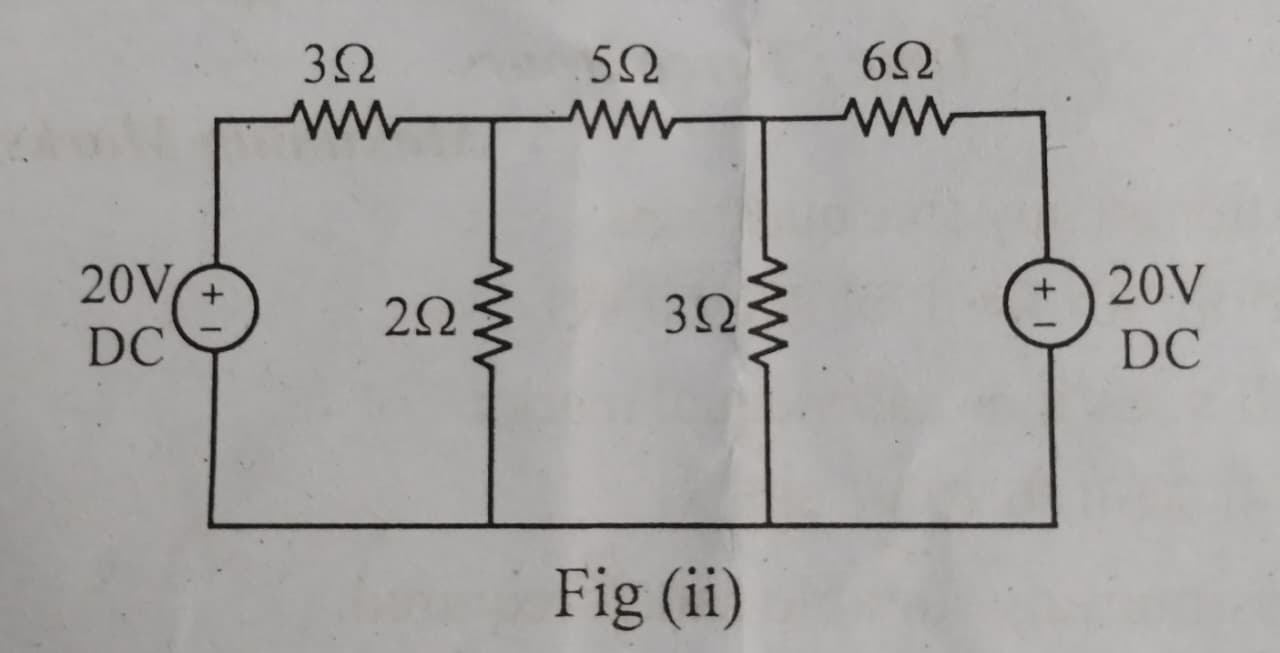
Q.19) Find the current through 5-ohm resistance in Fig (ii) using mesh current analysis.
(June-2025)
Expected Sample Questions for Dec-2025 Exam (Based on Syllabus Analysis)
Q.1) State and explain Thevenin’s Theorem. Find the Thevenin equivalent circuit across terminals A and B for a given network. (Predicted)
Q.2) Explain Norton’s Theorem. Determine the current flowing through load resistance using Norton’s theorem. (Predicted)
Q.3) State Maximum Power Transfer Theorem. Derive the condition for maximum power transfer in DC circuits. (Predicted)
Q.4) Derive the relationship between Star and Delta connected resistances. Convert a given Star network into Delta. (Predicted)
Q.5) Using Nodal Analysis, find the node voltages in a circuit containing both independent and dependent current sources. (Predicted)
Unit – II : AC Circuits
1- phase AC Circuits: Generation of sinusoidal AC voltage, definition of average value, R.M.S. value, form factor and peak factor of AC quantity , Concept of phasor, Concept of Power factor, Concept of impedance and admittance, Active, reactive and apparent power, analysis of R-L, R-C, R-L-C series & parallel circuit. 3-phase AC Circuits: Necessity and advantages of three phase systems, Meaning of Phase sequence, balanced and unbalanced supply and loads. Relationship between line and phase values for balanced star and delta connections. Power in balanced & unbalanced three-phase system and their measurements
Previous Years questions appears in RGPV exam.
Q.1) Draw Phasor diagrams of the following circuits: i) Series R-L-C when $X_L > X_C$, ii) Series R-L-C when $X_L < X_C$, iii) Series R-L-C when $X_L=X_C$. (Nov-2022)
Q.2) A 3-$\phi$ balanced system supplies 110V to a delta connected load whose phase impedance is equal to $(3.54+j3.54)\Omega$. Determine the line currents and draw the Phasor diagram. (Nov-2022, Dec-2024)
Q.3) Draw Phasor diagram of a 3-phase delta connected load and find the relation between phase and line voltages and currents. (Nov-2022, June-2024)
Q.4) A 220 V, 100 Hz, A.C source supplies a series RLC circuit with a capacitor and a coil. If the coil has 50 mH inductance, find at a resonance frequency of 100 Hz, what is the value of capacitor? (Nov-2022)
Q.5) Define the following: i) Alternating Quantity, ii) R.M.S. Value, iii) Average value, iv) Form factor, v) Peak factor. (June-2023, June-2024, Dec-2024)
Q.6) A coil having a resistance of 10 ohms and an inductance of 0.2H is connected in series with a $100 \times 10^{-6}$ F capacitor across a 230V, 50Hz supply, Calculate: i) The active and reactive components of the current, ii) The voltage across the coil, Draw the phasor diagram. (June-2023)
Q.7) A balanced star connected load of $8 + 6j$ ohm is connected across three phase, 50Hz, 440V supply system. Calculate: i) Line current, ii) Power absorbed, iii) Reactive volt ampere. (June-2023)
Q.8) Explain the following terms pertaining to an A.C. wave: i) Time period, ii) RMS value, iii) Average value, iv) Form factor. (Dec-2023)
Q.9) A choke coil has resistance of 10 ohm and inductance of 0.05H is connected in series with an condenser of 100 µF. The whole circuit has been connected to 200 V, 50 Hz supply. Calculate: i) Impedance, ii) Current, iii) Power Factor, iv) Real Power. (Dec-2023)
Q.10) Derive an expression of impedance, current, power factor, power in watts in RLC series circuit. (Dec-2023)
Q.11) Discuss about active, reactive and apparent power in series RLC circuits. (Dec-2023)
Q.12) Define the following: i) Average value of AC voltage, ii) RMS value of AC voltage, iii) Power factor, iv) Active power, v) Reactive power, vi) Apparent power, vii) Three phase balanced supply. (June-2024)
Q.13) A 220 volt, 50 Hz supply is given to a series R, L, C circuit having a resistance of 50$\Omega$, Inductance of 0.2H and capacitance of 100 µF. Calculate impedance, Current in the circuit and Voltage across R, L, C. (June-2024)
Q.14) Write a short note on: Power in balanced and Unbalanced Three Phase System. (June-2024, Dec-2024)
Q.15) Define the average value, RMS value, form factor, and peak factor of an AC quantity. How are these parameters calculated for a sinusoidal waveform? (Dec-2024)
Q.16) A coil of resistance 10Ω and inductance 0.1H is connected in series with 150µF capacitor across a 200V, 50Hz supply. Calculate: i) Inductive reactance, ii) Capacitive reactance, iii) Impedance, iv) Current, v) Power factor, vi) Voltage across the coil, vii) Voltage across capacitor. (Dec-2024)
Q.17) Define the following with respect to alternating quantity: i) R.M.S. value, ii) Peak value, iii) Average value, iv) Instantaneous value. (June-2025)
Q.18) A 4 ohm resistor is connected to a 10 mH inductor across a 100 V, 50 Hz voltage source. Find the input current, voltage across resistor and inductor, power factor of the circuit and the real power consumed to the circuit. (June-2025)
Q.19) Explain the role of resistance, capacitance and inductance in an electric circuit. (June-2025)
Expected Sample Questions for Dec-2025 Exam (Based on Syllabus Analysis)
Q.1) Explain the Two-Wattmeter method for measuring power in a three-phase system. Derive the expression for power factor. (Predicted)
Q.2) Define Resonance in Series RLC circuit. Derive the expression for Resonant Frequency, Quality Factor, and Bandwidth. (Predicted)
Q.3) Explain the phenomenon of Parallel Resonance. Derive the condition for resonance in a parallel RLC circuit. (Predicted)
Q.4) Compare Series and Parallel Resonance circuits based on impedance, current, and power factor. (Predicted)
Q.5) A factory has a lagging power factor. Explain how power factor can be improved using a capacitor bank. Calculate the required capacitance for a given load. (Predicted)
Unit – III : Magnetic Circuits
Magnetic Circuits: Basic definitions, magnetization characteristics of Ferro magnetic materials, self inductance and mutual inductance, energy in linear magnetic systems, coils connected in series, AC excitation in magnetic circuits, magnetic field produced by current carrying conductor, Force on a current carrying conductor. Induced voltage, laws of electromagnetic Induction, direction of induced E.M.F. Single phase transformer- General construction, working principle, e.m.f. equation, equivalent circuits, phasor diagram, voltage regulation, losses and efficiency, open circuit and short circuit test
Previous Years questions appears in RGPV exam.
Q.1) Draw the typical normal magnetization curve of ferromagnetic material. (Nov-2022)
Q.2) The no-load ratio required in a single-phase 50 Hz transformer is 6600/600 V. If the maximum value of flux in the core is to be about 0.08 Wb, find the number of turns in each winding. (Nov-2022)
Q.3) Enumerate the various losses in a transformer. How these losses can be minimized? (Nov-2022)
Q.4) State the different types of transformers. Describe the construction and general principle of transformer. (June-2023)
Q.5) What do you understand by Self inductance and mutual inductance? Derive the relation between Self inductance and Mutual Inductance. (June-2023, June-2024, Dec-2024)
Q.6) Open circuit and short circuit test on a single phase transformer gave the following results: $V_0=200V, I_0=0.7A, W_0=20$ Watt Test from primary side. $V_s=10V, I_s=10A, W_s=40$ Watt test from secondary side. Determine the equivalent circuit parameters referred to primary side. (June-2023, Dec-2023, Dec-2024)
Q.7) Discuss about magnetization characteristics of ferromagnetic material. (Dec-2023, June-2024, Dec-2024)
Q.8) Discuss the laws of Electromagnetic induction. (Dec-2023, Dec-2024, June-2024)
Q.9) Write a short note on: Open circuit and short circuit test. (Dec-2023)
Q.10) Draw the complete phasor diagram of a single phase transformer for an inductive load. Also write the notations used for all voltages and currents used in the phasor diagram. (June-2024)
Q.11) Explain Faraday's laws of electromagnetic induction. (June-2025)
Q.12) Explain the working principle of a single-phase transformer. (June-2025)
Q.13) In a 25 kVA, 2000/200 power transformer the iron and copper losses are 350W and 400W respectively. Calculate the efficiency at full load. (June-2025)
Q.14) Write short notes on: Compare electric and magnetic circuit. (June-2025)
Q.15) Write short notes on: B-H curve. (June-2025)
Expected Sample Questions for Dec-2025 Exam (Based on Syllabus Analysis)
Q.1) Derive the EMF equation of a single-phase transformer. Explain the significance of turns ratio. (Predicted)
Q.2) Explain Hysteresis loss and Eddy current loss in magnetic circuits. How are they minimized in transformer core design? (Predicted)
Q.3) Draw and explain the equivalent circuit of a transformer referred to primary and secondary sides. (Predicted)
Q.4) Define Voltage Regulation of a transformer. Explain the condition for zero voltage regulation and maximum voltage regulation. (Predicted)
Q.5) Differentiate between Electric and Magnetic circuits with analogies for EMF, Current, Resistance, etc. (Predicted)
Unit IV: Electrical Machines
Construction, Classification & Working Principle of DC machine, induction machine and synchronous machine. Working principle of 3-Phase induction motor, Concept of slip in 3- Phase induction motor, Explanation of Torque-slip characteristics of 3-Phase induction motor. Types of losses occurring in electrical machines. Applications of DC machine, induction machine and synchronous machine.
Previous Years questions appears in RGPV exam.
Q.1) Explain in detail the Applications of DC Machines. (Nov-2022)
Q.2) Explain the construction and working principle of three-phase induction motor with suitable diagram. (Nov-2022, June-2023, Dec-2024, June-2025)
Q.3) What is the difference between a separately excited and a self-excited generator? (Nov-2022)
Q.4) An 8-pole DC machine has a wave winding containing 600 conductors. Calculate the generated e.m.f when the flux per pole is 0.08 Wb and speed is 215 rpm. If the flux per pole is made 0.05 Wb. At what speed should the armature be driven to generate 5001V. (Nov-2022)
Q.5) A three phase, 6 pole, 50 Hz induction motor has a slip of 1% at no load and 3% at full load, Find: i) Synchronous Speed, ii) No Load Speed, iii) Full Load Speed, iv) Frequency of rotor current at full load. (June-2023)
Q.6) Discuss about types of losses occurring in electrical machine. (June-2023)
Q.7) Write a short note on: Torque-Slip Characteristics. (June-2023, Dec-2023, June-2024)
Q.8) Draw and explain the complete Torque-slip characteristics of 3 phase induction motor. (Dec-2023)
Q.9) The core loss in a 3 phase induction motor is 100W and equals the mechanical loss, stator copper loss is 150W. When developing 2000W as the shaft power. What is the efficiency of the machine. Assume the slip as 4%. (Dec-2023)
Q.10) Explain the construction and working principle of a DC machine with the help of neat diagram. (June-2024)
Q.11) A 6 pole alternator running at 1200 rpm supplies a three phase induction motor wounded for 4 poles. If the rotor induced emf makes 3 alternator per second. Find the actual rotor speed. (June-2024)
Q.12) Describe a D.C. machine with suitable sketches, focusing on its main parts and construction details. (Dec-2024)
Q.13) A three-phase 440V, 50hp, 50Hz induction motor delivers rated output at 1440 rpm. Calculate: i) Number of poles, ii) Synchronous speed, iii) Slip, iv) Slip rpm, v) Rotor speed, vi) Rotor EMF at operating speed. (Dec-2024)
Q.14) Explain with schematic diagram different parts of D.C. machines. (June-2025)
Expected Sample Questions for Dec-2025 Exam (Based on Syllabus Analysis)
Q.1) Derive the EMF equation of a DC Generator. Explain the significance of each term. (Predicted)
Q.2) Explain the different methods of speed control of DC motors (Armature control and Field control). (Predicted)
Q.3) Explain the concept of Rotating Magnetic Field (RMF) in a 3-phase induction motor. Show that the resultant flux is constant. (Predicted)
Q.4) Differentiate between Squirrel cage and Slip ring induction motors based on construction, characteristics, and applications. (Predicted)
Q.5) Explain the working principle of a Synchronous Generator (Alternator). What are its main applications? (Predicted)
Unit V : Basic Electronics
Number systems & Their conversion used in digital electronics, De morgan’s theorem, Logic Gates, half and full adder circuits, R-S flip flop, J-K flip flop. Introduction to Semiconductors, Diodes, V-I characteristics, Bipolar junction transistors (BJT) and their working, introduction to CC, CB & CE transistor configurations, different configurations and modes of operation of BJT
Previous Years questions appears in RGPV exam.
Q.1) Draw and explain the output characteristic of a NPN transistor operation in CE configuration. (Nov-2022)
Q.2) Write short notes on: a) R-S flip-flop, b) J-K flip-flop, c) De-Morgan's theorem. (Nov-2022, Dec-2023, June-2024, Dec-2024, June-2023, June-2025)
Q.3) Draw and explain the V-I characteristics of a PN junction (Diode). (June-2023, June-2025)
Q.4) Draw the circuit and explain the characteristics of CB configuration. (June-2023)
Q.5) What do you understand by Adder circuit? Draw and explain the working principle of full adder circuit. (Dec-2023)
Q.6) In a fixed bias circuit using n-p-n transistor, find the operating point if $V_{CC}=24V, R_B=220k\Omega, R_C=4.7k\Omega$. (Dec-2023)
Q.7) What do you understand by semiconductor. Explain the different types of semiconductors in details. (June-2024)
Q.8) What is the need of full adder circuit? Design a Full adder circuit with truth table and logic diagram. (June-2024)
Q.9) Solve for x: i) $(257)_{10} = (x)_2$, ii) $(21.625)_{10} = (x)_8$, iii) $(BC.2)_{16} = (x)_8$, iv) $(33)_{10} = (201)_x$. (Dec-2024)
Q.10) With the help of input and output characteristics, explain the operation of a BJT in common emitter configuration. (Dec-2024)
Q.11) Explain the working principle of common base transistor. (June-2025)
Q.12) Write short notes on: Logic gates. (June-2025)
Expected Sample Questions for Dec-2025 Exam (Based on Syllabus Analysis)
Q.1) Explain the operation of a Half Wave and Full Wave Rectifier with circuit diagrams and waveforms. (Predicted)
Q.2) Explain the V-I characteristics of Zener diode and its application as a voltage regulator. (Predicted)
Q.3) Perform the following conversions: (i) Decimal to Hexadecimal, (ii) Binary to Octal, (iii) Hexadecimal to Binary. (Predicted)
Q.4) Explain the working of J-K Master-Slave Flip Flop with its truth table and logic diagram. (Predicted)
Q.5) Realize AND, OR, and NOT gates using Universal gates (NAND and NOR). (Predicted)